

Dealer Profitability Training

Used Car Dealer Profitability Training
Boosting front-end and back-end gross, turning inventory faster, and improving cash flow all start with a measurable plan. Our used car dealer profitability training is a practical roadmap for independent and franchise operators focused on sustainable growth. You will learn proven methods to acquire vehicles at the right cost, set market-accurate pricing, recondition efficiently, reduce wholesale losses, and protect margins with disciplined processes. The training aligns sales, service, marketing, and accounting so every department supports profit and payment performance. Instruction is built from real store data and field-tested playbooks, not theory. Whether you manage one rooftop or multiple locations, you will find repeatable strategies to lift KPIs and reduce risk. Explore related education that complements profitability, including used-car-dealer-operations-training and used-car-dealer-regulatory-compliance-training, and learn how it all fits together with dealer-performance-optimization-education.
Use this page to register members of your dealership ASAP!
ONLY $299 For Each Addt'l Dealership Attendee
CAESARS ROOMS DISCOUNTED TO $189 a night
(Plus Resort Fee)
This page organizes the core elements of used car dealer profitability training into clear, actionable topics. Expect practical frameworks, benchmark targets, and implementation checklists that blend sales execution, inventory science, and compliance discipline. For insights from the field, visit blog. To learn who benefits most, see who-should-attend-bhph-united-summit and about-us for background on our approach.
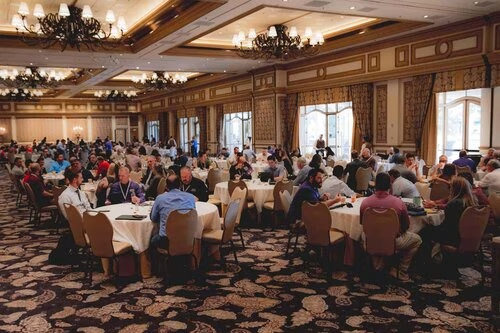
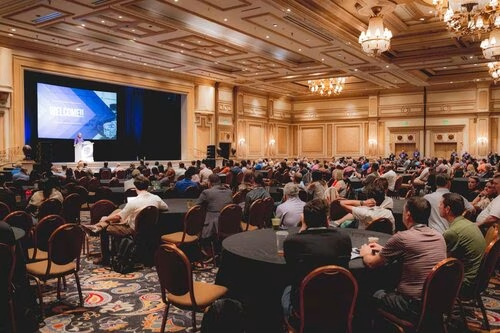
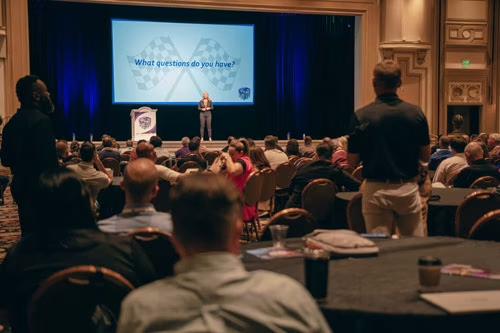
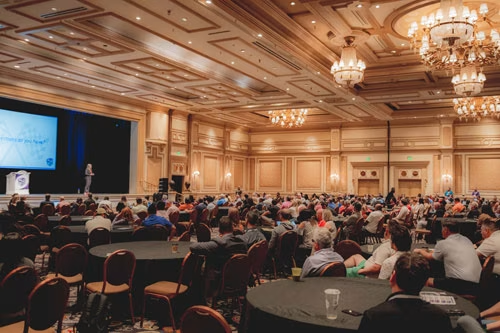
What is Used Car Dealer Profitability Training
Used car dealer profitability training is a structured learning path that equips owners, general managers, sales managers, controllers, service leaders, and collections teams with the tools to create consistent, predictable profit. The program connects strategy with execution and defines the daily, weekly, and monthly habits that generate gross while protecting compliance and customer satisfaction. By aligning pricing, merchandising, digital marketing, underwriting discipline, and service turnaround, operators unlock faster inventory turns, healthier front-end PVR, stronger back-end penetration, and steadier cash flow.
Core Profit Drivers Covered
- Inventory acquisition strategy and aged-stock prevention
- Market-based pricing and merchandising for faster turns
- Reconditioning workflow to control costs and days in recon
- Sales process discipline that maximizes front-end PVR and close rate
- F and I menu structure and reserve optimization with compliance guardrails
- Collections and risk practices that stabilize cash flow for in-house programs
- KPI dashboards, forecasting, and monthly operating review cadence
Inventory Acquisition and Turn Strategy
Profitability starts with the buy. The training details sourcing mixes that balance lane, trade, street purchase, and digital wholesale, then layers in cost-to-market targets that protect retail spread. Operators learn how to define an ideal vehicle profile by segment, mileage, cost to market, recon band, and demand score. We cover negotiation tactics, condition report review, and walk-away rules that keep your average cost per unit aligned with PVR goals. You also receive an aged policy with action triggers at 20, 30, 45, and 60 days that guide price movement, photo refresh, VDP updates, and wholesale exit decisions.
Pricing, Merchandising, and Digital Visibility
Market-based pricing tightens time to sale. We outline a pricing ladder tied to days-in-inventory that is responsive to comp sets and search demand. Merchandising checklists ensure every unit has complete photo sets, feature highlights, condition transparency, and keyword-rich descriptions. We map how SRP and VDP engagement signal when to adjust price, photos, or ad syndication. The training integrates with used-car-dealer-marketing-strategy-education and dealer-technology-training-education to show how to unify SEO, paid search, and marketplace feeds into one coherent playbook.
Reconditioning Speed and Cost Control
Every day in recon is a day without revenue. You will learn to set standard job times, define parts sourcing rules, track sublet costs, and stage approvals to hold line items accountable. A tiered recon policy aligns spend to expected gross and risk band, so you do not over-invest in low-demand profiles. Visual status boards reveal bottlenecks so vehicles do not stall between inspection, parts, and photography. These practices align with dealer-service-department-training and used-car-dealer-service-operations-training.
Sales Process That Protects Gross
We standardize needs discovery, presentation, demo, and write-up, using a one-price or controlled-price approach that protects margin while preserving trust. Training includes appointment-setting scripts, road-to-the-sale milestones, desking guidelines, and objection handling that supports PVR without discount spirals. Sales leaders receive coaching rhythms, one-on-ones, and daily huddles that reinforce behaviors. For deeper practice, see dealer-sales-training-education and used-car-dealer-sales-process-training.
F and I Structure and Compliance
Back-end profit must be earned within clear compliance guidelines. The program covers value-based menu presentation, lender program alignment, product penetration tracking, and reserve management. We reinforce proper disclosure, adverse action documentation, and Red Flags procedures. Guidance draws on used-car-dealer-accounting-education and used-car-dealer-regulatory-compliance-training, plus references to buy-here-pay-here-legal-compliance-education and federal-compliance-training-for-dealers for teams operating in mixed retail and in-house environments.
Collections and Risk Practices for In-House Financing
For operators offering in-house or hybrid structures, stability comes from clear underwriting, early-stage communication, and consistent follow up. We define credit policy bands, documentation standards, verification steps, and payment performance KPIs. The collections segment explains account segmentation, promise to pay management, field calls, extensions, and loss mitigation playbooks that prioritize curing accounts over repossessions. Linkages to buy-here-pay-here-collections-training, buy-here-pay-here-payment-performance-education, and dealer-collections-training provide advanced depth.
Technology, Data, and Automation
Technology turns process into repeatable results. We cover CRM workflows, inventory pricing tools, recon software, and dashboard automation. Teams learn how to build scorecards that tie VDP leads, show rates, pencil outcomes, and gross to daily activities. We also address data hygiene and how to audit process adherence with simple exception reporting. For more, see used-car-dealer-technology-integration-training and dealer-technology-training-education.
Leadership Routines and Team Development
Great processes need leadership cadence. We teach how to establish weekly operating reviews, pipeline meetings, recon standups, and prospecting blocks. Managers receive interview rubrics, onboarding plans, and coaching templates that reduce ramp time and turnover. Alignment across departments is reinforced with shared KPIs and transparent dashboards. Explore dealer-leadership-development-training and used-car-dealer-leadership-training for additional frameworks.
KPI Targets and Benchmarks
A sample scorecard includes inventory turn, average days in recon, cost to market, front-end PVR, back-end PVR, close rate, appointment show rate, average trade ACV, and marketing cost per retail unit. Operators also track net profit per retail unit after recon and pack, as well as cash conversion cycle. Collections-centric stores add delinquency buckets, roll rates, and recovery efficiency. The training explains how to set goals by market size, price band, and sourcing mix, then hold monthly reviews to course correct.
Scaling to Multiple Locations
Multi-store operators need standardization and local flexibility. We show how to define common policies, shared playbooks, and centralized reporting while allowing each store to tailor pricing and merchandising to its micro-market. Centralizing title, accounting, and vendor negotiations often frees local teams to focus on sales and service throughput. For operators planning expansion, visit dealer-operations-management-training and used-car-dealer-growth-strategy-education.
How This Connects With Adjacent Programs
Profitability is stronger when training is integrated. Many dealers pair this curriculum with used-car-dealer-operations-best-practices to tighten daily execution, dealer-marketing-training-education to increase high-intent leads, and dealer-accounting-training-education to improve month-end accuracy. Stores with subprime and BHPH volume layer in buy-here-pay-here-operations-training, buy-here-pay-here-profitability-training, and subprime-operations-best-practices to ensure unified playbooks across credit tiers.
Real World Implementation Roadmap
- 30 days: implement pricing ladder, recon SLA, appointment scripts, and a daily huddle
- 60 days: deploy merchandising checklists, automate dashboards, and tighten aged policy triggers
- 90 days: refine sourcing mix, renegotiate vendor terms, and expand product menu penetration
- 120 days: add advanced KPI reviews, manager scorecards, and multi-store playbook updates
Program Formats and Resources
Training is delivered through workshops, toolkits, and peer learning. For in-person and virtual options, see education-and-events and dealer-workshops-and-training. If you plan professional development across roles, browse dealer-professional-development-training and dealer-peer-learning-education. Event schedules and session lineups are outlined at 2025-event-agenda and 2025-featured-speakers. For travel planning, reference discounted-airfare. Company background and principles are available at about-us and privacy-policy. Contact options are at contact-us.
