
for Used Car, BHPH, and Independent Operators
Staying compliant with state regulations is essential for used car dealerships, buy here pay here operations, and independent dealers. Our state compliance education for dealers breaks down complex rules into simple, actionable steps that protect your dealership, reduce risk, and support long term growth. From disclosures and collections to titling, repossessions, underwriting, and record retention, you will learn how to operationalize the right processes for your market and business model.
Whether you operate in one state or across multiple regions, this resource helps you standardize your program and adapt to state specific requirements. Gain clarity on what regulators expect, how to document compliance, and how to train staff so that compliance becomes part of your daily workflow. Explore related topics across operations, collections, underwriting, and audit preparedness, and connect state level rules with real world practices that improve customer experience and profitability.
Use this page to register members of your dealership ASAP!
ONLY $299 For Each Addt'l Dealership Attendee
CAESARS ROOMS DISCOUNTED TO $189 a night
(Plus Resort Fee)
This page explains how state level requirements intersect with dealership operations and buy here pay here finance practices. You will find frameworks, checklists, and references to deeper training that help you design, implement, and monitor an effective compliance program. Use the linked resources to align policies, strengthen documentation, and keep your team confident and consistent.
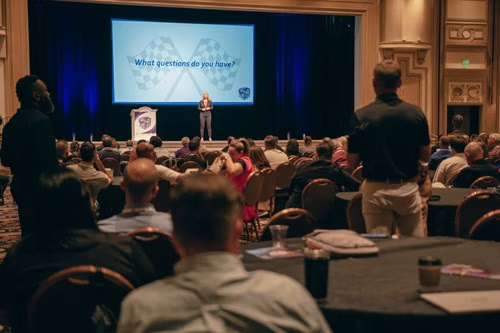
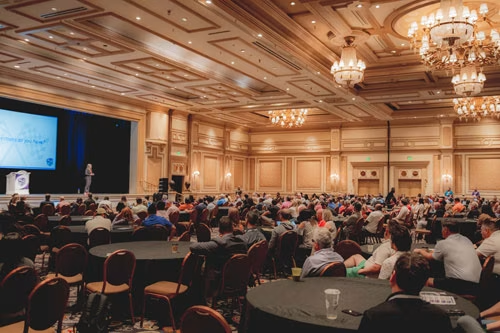
State compliance for dealers is more than a set of rules. It is a disciplined approach to how you sell, finance, service, collect, and store information. Each state interprets consumer protection, disclosures, fees, collections practices, repossession procedures, electronic communications, and data security in its own way. That means your policies, deal jacket structure, workflows, and training must be built around your state statutes and any relevant guidance from attorneys general, motor vehicle divisions, and financial regulators.
If you are a used car dealer, buy here pay here operator, or independent retailer offering in house financing or leasing, state compliance touches every step of your customer journey. When your forms, scripts, and system permissions match your state’s requirements, operational risk goes down and performance goes up. The goal of this page is to give you a clear map of what to cover, how to structure your program, and where to find deeper support for your team across sales, underwriting, collections, service, and accounting.
Who benefits from state compliance education
- Used car dealers that want clean deals and fewer chargebacks or complaints
- BHPH operators integrating sales, underwriting, collections, and service with state rules
- Multi location groups harmonizing a core policy set with state specific addenda
- New general managers, controllers, and compliance leads building a first program
Core topics every dealer should operationalize
- Selling and advertising disclosures, price displays, and fee transparency
- Credit evaluation, underwriting guidance, and adverse action requirements where applicable
- BHPH specific elements like payment schedules, grace periods, payment receipts, and late fee rules
- Collections practices including call frequency, text opt in, repossession notices, and reinstatement terms
- Titling, registration, taxes, and tag processes with proof of timing and accuracy controls
- Record retention schedules and audit trails that match state and federal guidance
For a deeper dive into BHPH focused subjects, see buy-here-pay-here-state-compliance-education, buy-here-pay-here-legal-compliance-education, and buy-here-pay-here-federal-compliance-education. If you operate primarily as a retail used car dealer, explore used-car-dealer-regulatory-compliance-training and used-car-dealer-compliance-education for aligned content and templates.
Designing a state specific compliance program that scales
Start with a core policy manual that reflects universal dealership standards. Then add state level exhibits that control disclosures, language, forms, notices, recovery timelines, communications, and fee limits. Tie each policy to a process step in your DMS or CRM, a role, and a control. Document evidence with time stamps, user IDs, and stored copies of forms or notices. This structure gives you both day to day consistency and auditable proof.
- Map rules to workflow: show exactly where each requirement lives in your sales and collections process
- Automate where possible: permissions, required fields, and time based tasks drive consistency
- Enable people: quick reference guides, huddles, and checkpoints align new hires and veterans
- Monitor: sample deals and accounts weekly with tiered checklists to catch gaps early
To align policy with performance, integrate compliance education with operator training such as buy-here-pay-here-operations-training, buy-here-pay-here-collections-training, and used-car-dealer-operations-training. Operational fluency reduces risk because staff understand not only the rule but also the why behind it.
High risk areas that often vary by state
Several topics create outsized risk if they are not tailored to your state. Use the list below to prioritize your reviews, update forms, and train teams.
- Advertising and pricing: total drive out price rules, doc fee caps, and required disclosures
- Payment application and grace periods: sequence rules for fees, principal, and interest where state law prescribes
- Repossession and reinstatement: notice timing, cure rights, personal property handling, and sale disclosures
- Electronic communications: consent for text or email, content rules, and recordkeeping standards
- Fees and add ons: state specific form language, caps, menu presentation, and refunds
For tactical guidance on collections and recovery, see buy-here-pay-here-collections-best-practices, buy-here-pay-here-repo-process-education, and buy-here-pay-here-reinstatement-strategy-training. For underwriting alignment, explore buy-here-pay-here-underwriting-education and subprime-underwriting-training if you serve mixed credit tiers.
Audit readiness and documentation
Audits reward documentation. Build an audit book that lives inside your DMS or cloud repository with read only controls. Organize it by policy area, then by state. Include laws or guidance references, approved forms with version dates, process maps, training logs, and sample proof files. Maintain a register of exceptions and how you remediated them. When you can demonstrate design, implementation, and monitoring, your posture improves and fines or corrective actions are less likely.
Use buy-here-pay-here-audit-preparedness-training and used-car-dealer-audit-preparedness-education to structure your binder, test controls, and train internal auditors. Pair this with dealer-operations-management-training so leaders can coach to the standard during daily one on ones and deal reviews.
Integrating compliance with profitability
Well designed compliance programs help profit. Clean disclosures reduce cancellations. Proper underwriting with state aligned stipulations lowers losses. Collections that follow state rules improve recovery rates and reduce complaints. Accurate titling and tax handling shortens cash cycles. The goal is not to layer extra work on your team. The aim is to make the right step the easy step throughout your systems and checklists.
To connect compliance with margin, consider buy-here-pay-here-profitability-training, dealer-performance-optimization-education, and buy-here-pay-here-portfolio-performance-training. Reinforce discipline with buy-here-pay-here-operations-best-practices and dealer-leadership-development-training so that expectations are consistent across stores and shifts.
Multi state operations
If you operate in multiple states, adopt a common core with state overlays. In your DMS and CRM, assign state profiles that trigger the right forms, notices, and fee tables. Create a state matrix for repossession timelines, disclosure elements, and communication rules so managers can quickly compare requirements. Schedule staged internal audits by state and rotate test samples monthly.
Regional learning tracks can help. See buy-here-pay-here-training-southeast, buy-here-pay-here-training-mid-atlantic, buy-here-pay-here-training-northeast, and buy-here-pay-here-training-midwest. For state specific tracks, explore buy-here-pay-here-dealer-education-texas and buy-here-pay-here-dealer-education-florida to see how local rules shape daily execution.
Staff training and role clarity
Everyone owns a piece of compliance. Sales needs accurate price displays, disclosures, and document delivery. Underwriting needs consistent stipulations and adverse action handling when applicable. Collections must follow contact, payment, and notice rules. Service teams should manage warranty disclosures and safety items properly. Accounting must retain documents and reconcile fees and taxes to state rules.
- Create role based checklists for the tasks that intersect with state rules
- Use short micro trainings and huddles to reinforce one topic per week
- Sample and coach live deals and accounts during daily reviews
Build skills with buy-here-pay-here-management-training, dealer-professional-development-training, and dealer-real-world-education. To connect training with day to day process, pair with dealer-technology-training-education and used-car-dealer-technology-integration-training so your systems enforce your policies.
Related education and events
If you want to go deeper through workshops and peer learning, review dealer-workshops-and-training, education-and-events, dealer-peer-learning-education, and dealer-industry-insights-education. You can learn more about speakers at 2025-featured-speakers and view sessions at 2025-event-agenda and summit-agenda. If you plan travel, see discounted-airfare and who-should-attend-bhph-united-summit to assess fit for your team.
Helpful links
Frequently asked questions
Build a forms inventory with version dates, owners, and state mappings. Lock templates, restrict editing, and tie each form to a DMS or CRM trigger so the correct version populates automatically based on state profile. Sample five deals per week to confirm accuracy.
Review quarterly and upon any statutory or regulatory change. Maintain a change log with effective dates, training confirmations, and system updates. Reissue quick reference guides when changes affect scripts, timing, or fee tables.
They look for policy manuals, training logs, deal jackets, collections notes, repossession notices, sale records, fee tables, and evidence your systems enforce steps. Provide samples, exception registers, and proof of remediation with dates and owners.
Obtain consent before texting, store opt ins, throttle contact attempts per state guidance, and script messages to avoid prohibited content. Use system driven tasks and templates that log time stamps and user IDs for every interaction.
Deliver role based modules with scenario practice tied to your forms and systems. Shadow live deals or calls with a checklist. Certify readiness with a short assessment and sample work review. Reinforce through weekly micro learning and coaching.
Next steps for your team
Use the resources across this site to benchmark your current state, close known gaps, and align systems with policy. If you are researching event sessions, speaker insights, and practical dealer education, visit education-and-events, 2025-event-agenda, 2025-featured-speakers, and dealer-workshops-and-training. If you want to suggest a topic for future coverage, see topic-suggestion. For broader strategy, explore dealer-growth-strategy-training and dealer-capital-strategy-education.
For general information about our approach and commitment to dealer success, see about-us and blog. If you have questions about data handling, review privacy-policy. You can reach our team through contact-us to discuss alignment between your state program and your operational goals.
