

Best Practices for Used Car Dealers

Running a successful buy here pay here operation requires consistent processes, disciplined underwriting, compliant collections, and a customer experience that supports on-time payments. This page brings together practical buy here pay here operations best practices tailored for independent and used car dealers. From inventory turn and reconditioning cycle time to credit policy, deal structure, payment processing, and portfolio analytics, you will find proven methods to strengthen performance and reduce risk. If you are building a playbook or refining an existing one, use this guide alongside deep-dive training such as buy here pay here operations training, buy here pay here compliance education, and buy here pay here collections training. Explore how to align people, process, and technology so every step from acquisition to payoff is measurable, accountable, and repeatable. Use the insights below to improve profitability, protect your portfolio, and build long term customer relationships.
Use this page to register members of your dealership ASAP!
ONLY $299 For Each Addt'l Dealership Attendee
CAESARS ROOMS DISCOUNTED TO $189 a night
(Plus Resort Fee)
The guidance below distills field-tested standards for buy here pay here dealers at every stage of maturity. When you are ready to go deeper, tap into buy here pay here dealer education and ongoing insights on the blog. Have questions about applying these practices in your market or operation size? Reach out through contact us so we can point you to focused resources.


Build a durable buy here pay here model
A well-run buy here pay here operation balances underwriting discipline with customer-centered servicing. Your results hinge on consistent credit policy, inventory matched to payment-to-income targets, frictionless payment options, and compliant collections that cure issues early. The following best practices map to daily workflows so your team can execute with clarity and confidence.
Inventory strategy and pricing discipline
Inventory sets the foundation for affordability, payment performance, and recoveries. Target vehicles that meet your customer profile and align with your credit policy. Use data from prior vintages to match make, model, mileage, and recon costs to your typical advance and target payment. Keep days-to-front-line tight to accelerate turns and reduce capital drag. Build a recon checklist and cost caps by category to protect gross while ensuring reliability that supports on-time payments.
- Standardize recon steps and approval thresholds to control spend and cycle time. See used car dealer service operations training and used car dealer inventory management training.
- Price for payment, not only for front-end gross. Align to target payment bands from your credit policy. Explore used car dealer pricing strategy education.
Credit policy and underwriting clarity
Document a clear buy here pay here credit policy with income verification steps, employment stability guidelines, residence history, references, PTI and DTI limits, and down payment standards. Underwriting should evaluate ability and willingness to pay, not only score. Verify income through dependable sources, confirm stability, and analyze budget so the payment fits. Train staff to follow the same checklist, escalate exceptions, and track exception performance by underwriter.
- Implement tiered down payments and term caps to protect PTI and collateral risk. See buy here pay here underwriting education and buy here pay here credit policy education.
- Require verified references and contact cadence at sale and first 90 days to enhance right-party contact.
Deal structure that supports payment success
Structure deals around realistic budgets. Anchor payments to net income cycles, typically weekly or biweekly, and schedule first payment based on paycheck date. Avoid stacking add-ons that inflate payment beyond PTI targets. Consider limited service contracts and reconditioning warranties that build trust without overstretching payment. Use automatic reminders and a welcome call program to set expectations and reinforce payment habits.
Compliance as a daily habit
Compliance is not a binder; it is a workflow. Train teams on state and federal rules, adverse action notices, privacy requirements, and disclosure accuracy. Keep forms current, document customer communications, and audit files for completeness. Monitor ancillary products and GPS or starter-interrupt usage for compliance with state law and disclosures. Build a recurring compliance calendar with file audits, payment contact sampling, and privacy policy reviews.
- Deepen knowledge with buy here pay here state compliance training and buy here pay here federal compliance education.
- Align internal practices with independent dealer compliance education and review your privacy policy annually.
Collections excellence and early intervention
Collections performance is built in the first 90 days. Use a proactive welcome program, confirm contact methods, and celebrate on-time streaks. Segment accounts by risk and days past due, define call-by-day and text-by-day strategies, and measure promise-to-pay kept rates. Document all contacts, outcomes, and follow-up dates. Prioritize right-party contact, same-day resolution, and courtesy holds with clear parameters. For accounts sliding past set thresholds, escalate to field visits or payment arrangements within policy.
- Equip teams with scripts and empathy training to resolve issues quickly. Explore buy here pay here collections best practices and buy here pay here payment performance education.
- Align repossession decisions with a clear matrix and track reinstatement outcomes. See buy here pay here repo process education and buy here pay here reinstatement strategy training.
Payment options and technology integration
Offer multiple compliant payment options: ACH, debit card, in-person kiosks, mobile app, and text-to-pay, with automated reminders and receipts. Integrate your dealer management system with payments, collections workflow, and inventory controls to eliminate double entry and reduce errors. Use dashboards for real-time KPIs like 1–10 day delinquency, 31-plus delinquency, recency, roll rates, and payment yield.
- Standardize processes through dealer technology training education and subprime technology integration training.
- Reduce friction at checkout through buy here pay here payment processing training.
Risk management and loss mitigation
Define a loss mitigation playbook that includes skip tracing workflows, GPS best practices where permissible, and reinstatement criteria. Analyze recoveries relative to time-to-repo, miles, and condition to refine decisioning. Create a feedback loop back to underwriting and inventory buys to avoid repeat issues. Track charge-offs by vintage and by underwriter to target coaching.
- Strengthen controls with dealer risk management training and buy here pay here loss mitigation training.
Portfolio management and analytics
Manage your book like an investment portfolio. Build static pool and vintage analyses to monitor cumulative loss curves, payment yield, and recovery rates. Compare cohorts by acquisition source, vehicle segment, down payment, and term. Use dashboards for weekly huddles so leaders can act early. Tie compensation to controllable metrics like delinquency roll rates, kept promises, and recon cycle time instead of only units sold.
- Level up with buy here pay here portfolio performance training and subprime portfolio management training.
Capital planning and cash flow
Sustainable growth depends on capital strategy. Model cash-in and cash-out across the life of a loan: down payment, tax and tag, recon spend, operating costs, charge-off timing, and recoveries. Build funding scenarios with lines of credit or forward flow partners. Maintain covenants with timely reporting and reconcile trust accounts and cash drawers daily. Protect margin by managing SG and A relative to portfolio yield.
- Explore dealer capital strategy education and buy here pay here capital strategy education to plan growth responsibly.
Staffing, training, and culture
Your processes work only when your people are trained, coached, and accountable. Document standard operating procedures for sales, contracting, funding, collections, and accounting. Create a training ladder for each role with checklists, ride-alongs, and scorecards. Reinforce a culture that celebrates on-time customer payments and ethical practices. Rotate collections and underwriting reviews to beat blind spots and share best plays.
- Develop leaders with dealer leadership development training and buy here pay here leadership training.
- Build role clarity with dealer HR training education and dealer professional development training.
Customer experience and retention
Retention lowers cost and increases lifetime value. Set clear expectations at delivery, provide a payment calendar, and send helpful reminders. Offer maintenance guidance and trustworthy service options. Create loyalty rewards for on-time streaks and referrals that fit your compliance framework. Proactively solve issues before they threaten the budget. Respect, clarity, and consistency drive payment behavior.
- Strengthen touchpoints through dealer customer experience education and buy here pay here customer retention training.
Marketing and the sales process
Market to your true customer profile with clear messaging about reliability, payment flexibility, and service support. Ensure the sales process validates income, residence, and references early. Align appointment setting to underwriting guidelines to avoid poor fits. Track lead sources to funded deals and payment performance, not just shows or sales. Coach the team to present payments that fit budget and pay cycle.
- Skill up with dealer marketing training education, subprime sales process training, and buy here pay here sales process training.
Service operations and recon control
Service excellence keeps customers mobile and paying. Manage recon with parts approval rules, flat-rate time guides, and vendor scorecards. Track time in bay and comeback rates. Communicate timelines transparently with customers to set expectations and limit rental or loaner needs. Collect data on failure modes to inform future purchases and recon standards.
- Improve throughput with used car dealer service operations training and dealer service department training.
Scaling to multiple locations
Before you expand, lock down SOPs, scorecards, and training. Centralize underwriting and collections standards, and deploy the same DMS and reporting across rooftops. Pilot in one store, document lessons, then roll out. Choose managers who are culture carriers and provide a cadence of audits and coaching visits.
- Prepare with buy here pay here multi location operations training and dealer advanced operations training.
Keep learning: events and resources
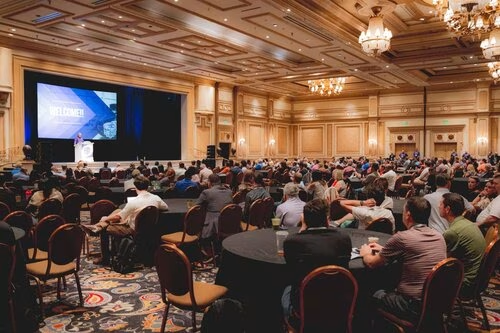
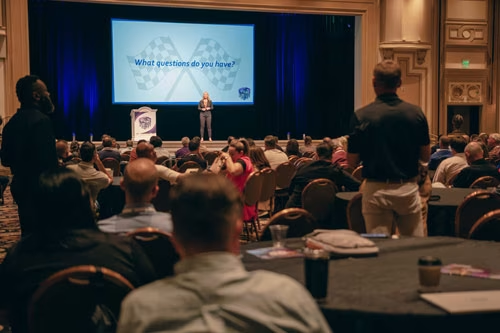
Stay current on regulations, technology, and market shifts through peer learning and expert-led sessions. Explore education and events for upcoming workshops, check who should attend bhph united summit, review the summit agenda and 2025 event agenda, or learn from 2025 featured speakers. For regional focus or topic deep dives, browse buy here pay here operations training, buy here pay here dealer education, and dealer workshops and training. For ongoing insights and research, visit the blog and research page template. When you need direct guidance or to connect with our team, see meet us or contact us.
Helpful internal resources
Buy Here Pay Here Operations FAQ
Core KPIs include 1–10 day delinquency, 31-plus delinquency, recency, roll rates by bucket, promise-to-pay kept rate, payment yield, charge-off rate by vintage, recovery rate, inventory days-to-front-line, recon cycle time, and average payment within PTI targets. Review trends in a weekly huddle to drive actions.
Common PTI targets range from 15 to 20 percent of verified net income, with all-in transportation DTI typically capped near 25 percent. Choose limits based on your market, vehicle reliability, and term lengths, then validate with static pool results and adjust by tier where appropriate.
Offer multiple low-friction options: ACH, debit card, text-to-pay, mobile app, and kiosks. Align payment dates to pay cycles, automate reminders, and provide instant receipts. Integration between your DMS and payment processor reduces errors and enables event-driven reminders that support on-time habits.
Tighten credit policy and verify income, stabilize PTI with the right vehicles and terms, and execute a strong first 90 day plan. Improve recon reliability, coach the sales process to set accurate expectations, and use data driven collections with early intervention. Audit exceptions and feed results back to inventory and underwriting.
Start with buy here pay here operations training for process fluency, then add buy here pay here compliance education for legal basics. Role specific courses include buy here pay here underwriting education, buy here pay here collections training, and buy here pay here payment processing training. Reinforce with checklists and coaching ride alongs.
