
Here Federal Compliance Education
Buy Here Pay Here federal compliance education helps independent dealers understand, implement, and sustain the practices required by federal rules that touch in-house financing. From credit disclosures to data security and fair lending, this page explains core requirements, shows how they relate to daily BHPH operations, and points to deeper training resources. Clear policies, routine staff training, and documented oversight can help reduce regulatory risk, improve customer trust, and keep your portfolio performing. Whether you are formalizing a compliance program or leveling up existing practices, you will find practical, dealer-focused guidance here. For expanded workshops and checklists, explore buy-here-pay-here-federal-compliance-training and buy-here-pay-here-legal-compliance-education. Use this content to align your team, tighten processes, and stay audit ready while you sell and service more vehicles with confidence.
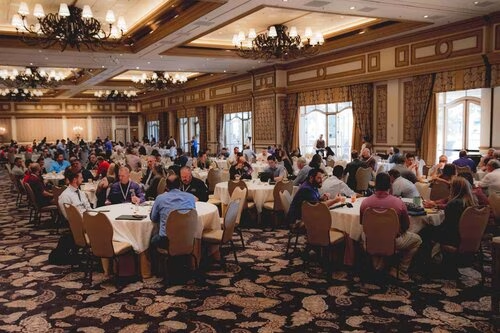
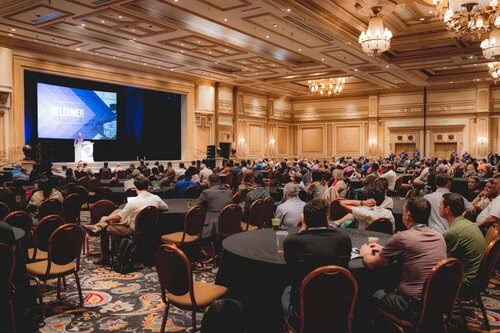
Use this page to register members of your dealership ASAP!
ONLY $299 For Each Addt'l Dealership Attendee
CAESARS ROOMS DISCOUNTED TO $189 a night
(Plus Resort Fee)
This Buy Here Pay Here federal compliance education overview highlights what matters most for dealerships that finance in-house. Use it to inform your policies, training calendar, and monitoring plan. For continued learning and peer insights, visit blog and education-and-events, and review dealer-compliance-best-practices to strengthen your program year round.
What Buy Here Pay Here Federal Compliance Means
Buy Here Pay Here dealers extend credit and service that credit in-house. That puts the store’s retail, collections, accounting, and IT workflows within the scope of several federal consumer protection and privacy laws. A practical compliance program blends written policies, role-based training, internal monitoring, vendor oversight, and documented corrective action when issues appear. The goal is not just to avoid penalties. The goal is consistent, fair, and secure processes that protect customers and support predictable cash flow.
Key Federal Laws and Rules Touching BHPH Operations
Dealers should confirm scope with experienced counsel, since applicability can vary by structure and product mix. The following areas are commonly relevant to BHPH operations:
- Truth in Lending Act and Regulation Z - standardized credit disclosures, finance charge and APR accuracy, advertising triggers, and contract clarity.
- Equal Credit Opportunity Act and Regulation B - fair lending, adverse action notices, consistent underwriting, and documentation of credit decisions.
- Fair Credit Reporting Act and Regulation V - permissible purpose, privacy notices, data accuracy, dispute handling, and credit reporting duties under Metro 2.
- Gramm Leach Bliley Act and FTC Safeguards Rule - written information security program, risk assessment, multi-factor authentication, encryption, monitoring, and vendor management.
- Red Flags Rule - identity theft prevention program, detection methods, response procedures, and staff training.
- FTC Holder Rule - consumer right to assert claims and defenses against the holder; required contract legend.
- FTC Act and UDAAP principles - unfair or deceptive acts or practices in sales, servicing, and collections.
- Servicemembers Civil Relief Act - interest rate relief on eligible pre-service obligations and specific repossession protections for covered borrowers.
- Telephone Consumer Protection Act and Telemarketing Sales Rule - consent for calls or texts to cell phones, Do Not Call, call time limits, and abandonment rules.
- CAN-SPAM - accurate email sender and subject, identification of promotional content, and opt-out processes.
- UCC Article 9 - default, cure notices, repossession requirements, commercially reasonable disposition, and post-sale accounting.
For deeper coverage and role-based learning, see buy-here-pay-here-federal-compliance-training, buy-here-pay-here-legal-compliance-education, and buy-here-pay-here-compliance-best-practices.
Building a Practical BHPH Compliance Program
A program that works in a busy BHPH store is lean, repeatable, and documented. Consider the following framework to align daily operations with federal requirements while protecting net charge-offs and customer satisfaction.
1. Governance and Ownership
Designate a compliance lead with authority to implement policies. Identify backups across sales, finance, collections, IT, and service. Keep a single source of truth for policies, procedures, and training records. Leadership should review key risk metrics quarterly and record decisions in meeting notes.
2. Policy and Procedure Library
Create concise procedures for credit evaluation, deal structure, delivery, payment processing, collections, repossession, credit reporting, complaints, and data security. Each procedure should map to applicable rules and include step-by-step tasks, forms, and system fields that must be completed. Cross-reference checklists to reduce misses.
3. Training by Role
Sales, underwriting, collections, accounting, and IT each face different compliance touchpoints. Use short modules with scenarios and job aids. Refresh annually or on policy changes. Track completion and assessments. Explore buy-here-pay-here-operations-training, buy-here-pay-here-underwriting-education, and buy-here-pay-here-collections-training for role-specific courses.
4. Monitoring and QA
Audit a sample of deals and collection actions weekly. Validate TILA disclosures, adverse action notices, deal call-backs, payment postings, complaint logs, and credit bureau reporting accuracy. Document findings, corrective actions, and follow-up. Independent audits or peer reviews can add perspective. For templates, see dealer-compliance-best-practices.
5. Vendor and Technology Oversight
Under the GLBA Safeguards Rule, you are responsible for the security posture of service providers that handle customer information. Maintain agreements with data protection clauses, review SOC or comparable assessments where applicable, and require incident notification. For DMS or payment gateway changes, test disclosures, data mapping, and user permissions before going live. Explore buy-here-pay-here-technology-integration-education for guidance.
Operational Focus Areas With Federal Implications
Underwriting and Adverse Action
Define objective credit policies, including minimum income verification, stability metrics, and debt burden ratios. Apply them consistently, document exceptions with a business reason, and log all counteroffers. When declining credit or materially changing terms, issue an accurate adverse action notice with the right reasons. See buy-here-pay-here-credit-policy-education for more depth.
Deal Structure and Disclosures
Populate disclosures directly from the deal structure within your DMS to reduce manual errors. Verify the finance charge, APR, payment schedule, and total of payments. Align any add-on products with rules and your policy. Keep version-controlled forms and validate advertising to avoid unqualified claims. For operations tips, visit buy-here-pay-here-operations-best-practices.
Collections, Hardship, and Repossession
Use standardized call scripts and respectful collection practices that align with UDAAP expectations. Track consent and dialing rules to meet TCPA requirements. Offer consistent hardship options based on policy and eligibility criteria, then document approvals. If repossession is necessary, follow UCC and state timelines, protect personal property, and issue accurate accounting of sale proceeds and deficiencies. See buy-here-pay-here-collections-best-practices and buy-here-pay-here-repo-process-education for details.
Credit Reporting and Dispute Handling
If you report to credit bureaus, furnish accurate data and correct errors quickly. Reconcile payment reversals and extensions so status fields remain consistent. Respond to direct and indirect disputes timely and maintain evidence files. Training is available in buy-here-pay-here-portfolio-performance-training and buy-here-pay-here-payment-performance-education.
Privacy, Security, and Incident Response
Run an annual risk assessment that covers administrative, technical, and physical safeguards. Implement multi-factor authentication, encryption in transit and at rest for sensitive data, role-based access, patching cadence, and endpoint protection. Train employees to spot phishing and social engineering. Keep an incident response plan with roles, regulators to notify where required, and customer communication templates. For structured learning, visit used-car-dealer-regulatory-compliance-training and buy-here-pay-here-compliance-risk-training.
Advertising, Lead Management, and Telephony
Advertising must present clear, accurate terms. If a trigger term appears, ensure required credit terms are disclosed with equal prominence. Record and honor Do Not Call requests. Capture and maintain written consent for autodialed or pre-recorded calls and for text messaging. Regularly test opt-out workflows and suppression lists. For marketing process guidance, see buy-here-pay-here-marketing-strategy-education and dealer-marketing-training-education.
Documentation, Recordkeeping, and Audit Readiness
Keep centralized, version-controlled policies, training logs, audit checklists, adverse action copies, complaint logs, privacy notices, and Safeguards documentation. Maintain a matter tracker for issues and root-cause fixes. Prepare an annual board or owner report covering program effectiveness, incidents, and planned improvements. These artifacts prove your risk management culture and speed up responses during exams or inquiries. For audit preparation resources, see buy-here-pay-here-audit-preparedness-training.
Common BHPH Federal Compliance Pitfalls
- Inconsistent adverse action notices or missing counteroffer documentation.
- Advertising APR or payment claims without accurate disclosures.
- Weak Red Flags procedures for verifying identity and responding to alerts.
- Credit reporting inaccuracies from payment reversals or extensions not synced to Metro 2 fields.
- Incomplete Safeguards documentation and vendor oversight.
How Education Supports Profitability
Compliance is not overhead when it prevents charge-offs, rescinded deals, and reputational damage. Trained teams quote accurate terms, verify identity, log consent, and collect with empathy. That reduces disputes and keeps customers on track. Use recurring micro-learning to reinforce essentials during peak selling seasons. For a comprehensive pathway, visit buy-here-pay-here-dealer-training-program and buy-here-pay-here-operations-education.
Helpful Internal Resources
Buy Here Pay Here Federal Compliance Education FAQs
Typical touchpoints include Truth in Lending and Regulation Z, Equal Credit Opportunity and Regulation B, Fair Credit Reporting, Gramm Leach Bliley and the FTC Safeguards Rule, the Red Flags Rule, the FTC Holder Rule, UDAAP standards, TCPA, and CAN-SPAM. UCC Article 9 governs secured repossessions and sale of collateral.
Yes. The Red Flags Rule requires a written identity theft prevention program. The FTC Safeguards Rule requires a written information security program, risk assessments, qualified individual oversight, multi-factor authentication, encryption practices, and vendor management with periodic reporting to leadership.
Use consistent credit criteria, log credit decisions, and when denying or materially changing terms, issue an adverse action notice with accurate reasons. If you make a counteroffer that is declined, you still owe an adverse action notice. Timeframes and content requirements follow Regulation B.
Capture written consent at delivery for calls and texts to mobile numbers, segregate numbers without consent, throttle call attempts, respect contact windows, honor opt-outs quickly, and audit dialer settings. Document consent and revocation. Train staff on scripts that align with respectful and compliant practices.
While state law and UCC Article 9 set many steps, federal UDAAP standards require fair, accurate notices and proper handling of customer property. For covered servicemembers, verify SCRA protections. Keep detailed logs, ensure commercially reasonable sale, and provide a clear post-sale accounting to the customer.
For broader used car dealer education, explore used-car-dealer-operations-training and used-car-dealer-regulatory-compliance-training. To keep your team aligned across functions, see dealer-operations-management-training and dealer-performance-optimization-education.
